There is a particular kind of patience required to build a fine jewelry collection, a willingness to acquire slowly, to resist the pull of trend, and to choose pieces that will outlast not only the season but the wearer. Unlike a wardrobe, which turns over with some regularity, fine jewelry is acquired with the expectation that it will remain — passed down, inherited, worn by hands and on occasions its first owner never imagined. This changes the calculus of every purchase. The question is not whether a piece appeals today but whether it will still hold meaning in forty years, whether its proportions will still flatter, whether its materials will still command respect. A collection built on this premise looks different from one assembled for immediate gratification, and the difference is visible from across a room.
The Foundational Pieces
Every collection begins with a foundation, a small set of pieces that carry the weight of daily and occasional wear and from which everything else extends. These are not arbitrary choices but pieces that have proven their utility across generations of wearers.
The Solitaire Ring
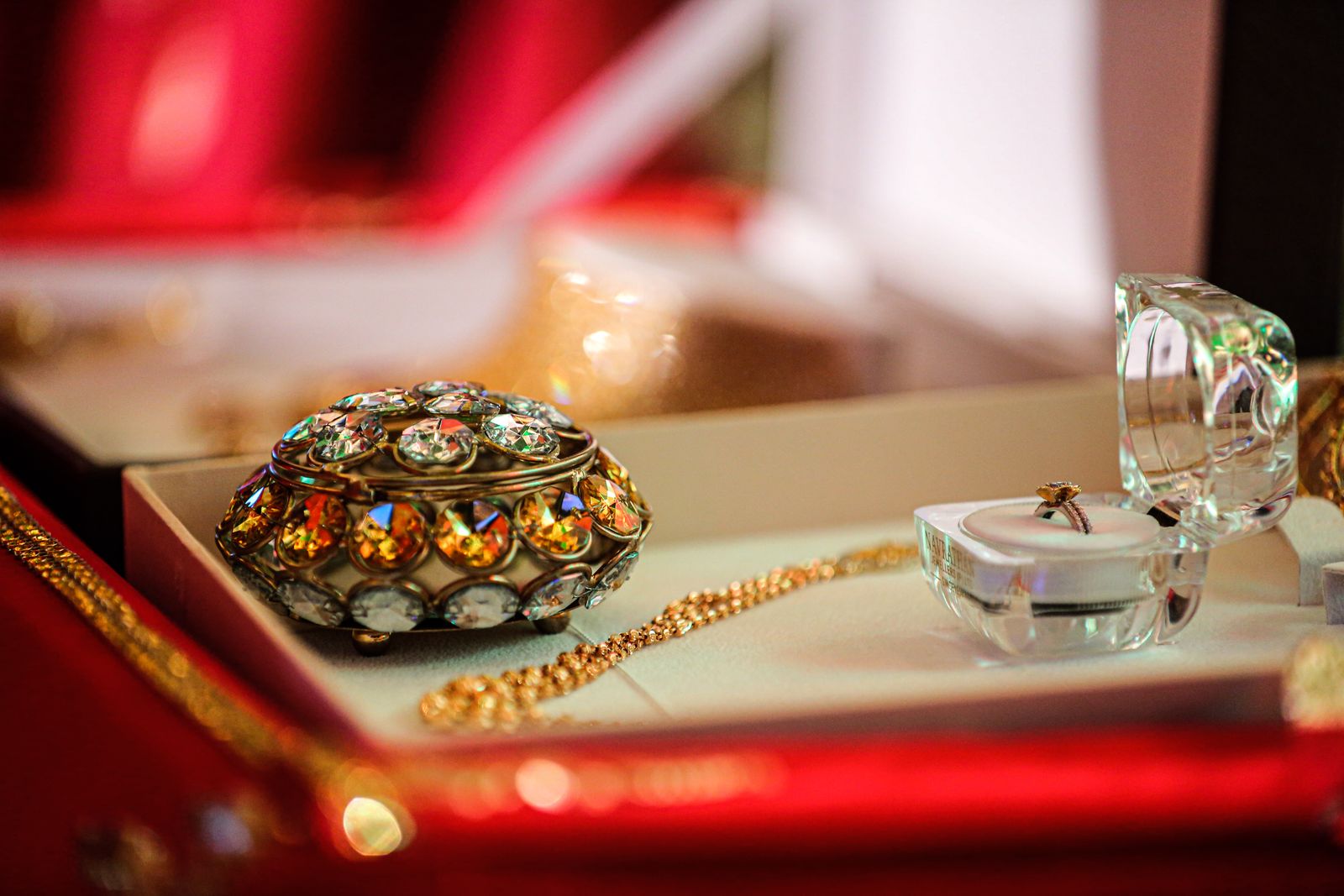
The solitaire — a single stone, usually a diamond, set simply — is the cornerstone of most collections. Its power lies in its restraint. Without side accents or elaborate settings, the solitaire directs all attention to the quality of the stone itself, which means the quality of the cut, the clarity, and the color must stand on their own. A well-chosen solitaire is never out of place: it reads as appropriate at a board meeting, a wedding, or a quiet dinner. Because it draws the eye so directly to the stone, it is the piece where compromise is most visible and where investment in quality pays the highest dividend.
Stud Earrings
Stud earrings, particularly diamond studs, are the second foundational piece, and they may be the most frequently worn item in any collection. They frame the face, they suit every neckline and every occasion, and they disappear into an outfit rather than competing with it. The decision between a larger pair and a finer pair is less important than the decision to choose a setting that flatters the ear and a stone quality that reads well at conversation distance. A pair of well-made studs will be worn hundreds of times a year, which makes them, on a cost-per-wear basis, among the most sensible acquisitions a collector can make.
The Pendant Necklace
A pendant on a fine chain — whether a single pearl, a gemstone, or a small diamond — provides a third anchor. Where the ring and the earrings sit close to the face, the pendant occupies the space between the collarbones and draws the eye downward, giving a collection vertical reach. A pendant should be chosen with the chain in mind: the chain must be fine enough to disappear but substantial enough to hold the pendant securely and to survive decades of daily wear.
Principles of Acquisition
Beyond the specific pieces, a collection is defined by the principles that guide its acquisition. These principles separate a collection from an accumulation, and they are what allow a jewelry box to grow in value and coherence rather than in clutter.
Quality Over Quantity
The single most important principle is that one excellent piece is worth more than several acceptable ones. A smaller number of well-chosen pieces, each of exceptional quality for its category, will always read more considered than a larger number of compromised pieces. This means acquiring fewer items, waiting longer between purchases, and spending more on each — but it also means that every piece in the box is one the wearer is proud to put on. A collection built on this principle has no filler, and the absence of filler is what gives a collection its authority.
Metal Consistency
A collection gains coherence when the metals are consistent. Mixing yellow gold, white gold, rose gold, and platinum across a small collection creates visual noise that diminishes every piece. Choosing a primary metal — yellow gold, for instance — and acquiring within that metal gives the collection a unified character and allows pieces to be worn together without friction. A secondary metal can be introduced deliberately, but the default should be consistency, and any deviation should be a choice rather than an accident.
Provenance and Documentation
Every piece in a collection that is intended to last generations should be acquired with its documentation intact. Certificates for stones, receipts of purchase, and records of any appraisal establish provenance and make the collection legible to those who inherit it. A piece without documentation is a piece with a story that fades; a piece with documentation is a piece whose story can be verified and continued. This is unglamorous work, but it is the work that separates a collection from a box of jewelry.
Building Beyond the Foundation
Once the foundation is in place, the collection can expand with intention. A statement ring for evenings, a bracelet that can be worn alone or stacked, a pair of drop earrings for occasions that demand more than a stud — these are the pieces that give a collection its personality. They should be chosen to complement rather than to compete with the foundation, and they should be acquired only when the foundation is secure. The temptation, when one begins to collect, is to acquire the interesting pieces first, but a collection without a foundation is a collection that cannot be worn together, and the joy of fine jewelry is as much in the wearing as in the owning.
Ultimately, a fine jewelry collection is a long project, and its value is not only monetary. The pieces gather meaning as they are worn — to dinners, to weddings, to ordinary days — and that meaning is part of what is passed along. A collection built with patience, on sound principles, with pieces of genuine quality, becomes more than the sum of its contents. It becomes a record of a life and a gift to those who come after, which is, in the end, what fine jewelry is for.