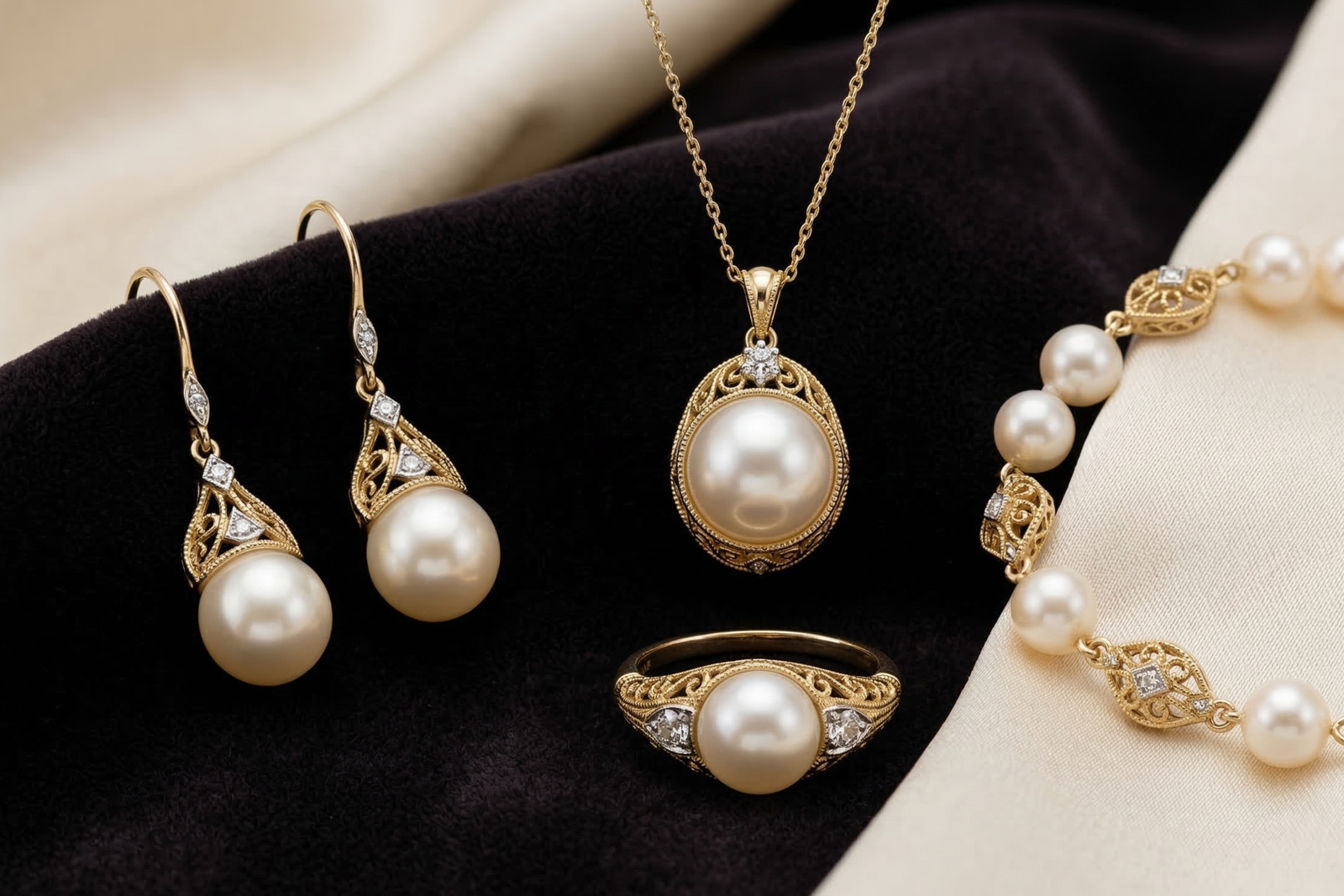
For a long time, the pearl carried a specific and limiting image. It was the gemstone of a particular generation, associated with twinsets and afternoon occasions, with a formality that felt increasingly out of step with how people dressed and lived. To wear a pearl strand was, for a period, to make a statement about tradition rather than style, and younger buyers who came of age in an era of minimalism and edge largely passed the pearl by. What has happened in recent years is something more interesting than a simple revival. The pearl has not returned to its former place; it has been reimagined, taken apart and reassembled by designers who respect the material but refuse to be bound by its conventions. The result is a gemstone that feels contemporary for the first time in a generation, and the transformation is worth examining.
The Pearl's Inherent Qualities
What makes the pearl worth reimagining is that it possesses qualities no other gemstone can replicate. A pearl is produced by a living creature — an oyster or a mussel — and it is the only gemstone that requires no cutting or polishing to reveal its beauty. Its luster, the deep, soft glow that seems to come from within rather than from the surface, is the product of layers of nacre deposited over years, and it is a quality that cannot be manufactured or imitated convincingly. This organic origin gives the pearl a warmth and a softness that sets it apart from the hard brilliance of faceted stones, and it is precisely this quality that contemporary designers have learned to exploit.
Luster and Overtone
The quality of a pearl is judged primarily by its luster — the sharpness and depth of the reflection from its surface — and by its overtone, the subtle secondary color that sits over the body color. A fine pearl will have a luster so sharp that it acts almost as a mirror, with the light reflected back in a way that seems to glow from within. The overtone, which may be rose, cream, or silver, adds complexity to the body color and gives each pearl a character of its own. These qualities are what make pearls compelling, and the contemporary designers working with them are choosing pearls for their luster and overtone rather than for the uniformity that once governed pearl jewelry.
How Designers Are Recontextualizing the Pearl
The reimagining of the pearl is happening across several fronts, each of which represents a different way of freeing the gemstone from its traditional settings and associations.
Asymmetry and Irregularity
For decades, the ideal pearl was perfectly round and perfectly matched, and a strand of identical pearls was the pinnacle of the form. Contemporary designers have moved in the opposite direction, embracing baroque pearls — those that are irregular, asymmetrical, and singular in shape — and building pieces around their individual character rather than their conformity. A single large baroque pearl, set on a simple gold chain, has a sculptural quality that a matched strand could never achieve, and its irregularity reads as intentional and modern rather than as a flaw. This willingness to treat each pearl as a unique object rather than as one of a set is perhaps the single most important shift in how the gemstone is being used.
Unexpected Combinations
Designers are also recontextualizing the pearl by pairing it with materials and forms that traditional pearl jewelry would never have allowed. Pearls set alongside diamonds in industrial-inspired settings, pearls threaded on leather cord, pearls combined with yellow gold in proportions that emphasize the warmth of both materials — these combinations draw the pearl out of its formal context and give it a new vocabulary. The effect is to make the pearl feel like a material with range rather than a material with a fixed role, and it opens the gemstone to wearers who would never have considered a traditional pearl strand.
Scale and Proportion
The scale of pearl jewelry has changed as well. Where the traditional strand was uniform and modest in size, contemporary pieces often use a single, large pearl as a pendant, or they play with dramatic variations in size within a single piece. A large South Sea pearl, measuring fourteen millimeters or more, has a presence that a strand of smaller pearls cannot match, and when it is set simply — on a fine chain, in a minimal gold cap — it reads as a statement of confidence in the material rather than as an exercise in tradition. The shift toward larger, individual pearls has been central to the gemstone's contemporary revival.
The Cultured Pearl and the Question of Origin
The pearl's revival has been made possible, in part, by the cultured pearl industry, which has expanded the range and availability of pearls far beyond what the natural pearl fisheries of the past could supply. A cultured pearl is produced by inserting a nucleus into an oyster or mussel and allowing the animal to coat it with nacre over a period of years. The result is a pearl that is, in material terms, identical to a natural one — the nacre is the same, the luster is the same — but the process is initiated and managed by humans. This has made pearls of exceptional quality available at prices that allow designers to experiment, and it has created a diversity of pearl types — Akoya, South Sea, Tahitian, freshwater — each with its own character and color range. The contemporary pearl jewelry that feels so fresh is, in many cases, the product of this expanded supply, and the designers working with the material today have a richer palette to draw from than any previous generation.
The pearl's journey from a symbol of tradition to a material of contemporary design is not complete, and it is, in a sense, ongoing. What is clear is that the gemstone has been freed from the narrow role it occupied for so long, and that the designers working with it are producing pieces that feel genuinely new. A pearl worn today can still be traditional, if tradition is what the wearer wants, but it can also be something else — sculptural, asymmetrical, unexpected, and unmistakably of its moment. That range, more than any single design, is what makes the pearl contemporary, and it is what will keep it relevant for the generation that is only now discovering what the gemstone can do.